Showing posts with label Pa. Show all posts

Monday, January 15, 2024

New Beyond the Battle Museum in Gettysburg Brings History Alive

In a darkened parlor, the thundering ka-boom of cannons and the whizzing of bullets spark imaginations.

Floorboards shake, as the occasional bullet strikes the side of the home and anxious voices in muffled tones discuss the horror of what’s happening outside. A dog whimpers, terror-stricken by the chaos. Some visitors get a lump in their throat brought about by the realness and the gravity of the immersive experience titled Caught in the Crossfire.

Children point to holes in residences. (Photo courtesy: Beyond the Battlefield Museum)

The exhibit is part of the Beyond the Battlefield Museum in Gettysburg and has been voted as one of the top 10 new museums in the country by USA Today. It uses cutting-edge technology to allow patrons to see, hear and feel what civilians experienced during the bloody Battle of Gettysburg in July 1863.

Ken Burns, the well-known documentarian who created the miniseries, The Civil War, and who visited the museum in February, described Caught in the Crossfire as “visceral.” “I don’t think I’ve ever seen anything like this,” he said.

Historian and author Garry Adelman echoed that sentiment. “I got chills and a little bit emotional at the same time,” he said--a sentiment that is echoed time and again by visitors, who often have to choke back tears as they imagine the emotional toll taken on the area's residents.

The 25,000-square-foot history center, located on Biglerville Road on the edge of the Gettysburg Battlefield, opened in April 2023, as part of the Adams County Historical Society. In 2020, the society launched a successful, $12 million campaign to construct a new, permanent home, which includes the museum.

The museum itself contains more than 1,000 artifacts and 12 interactive exhibits, including the accounts of eyewitnesses and their experiences before and after the Civil War.

To begin the tour, guests are transported back to the Jurassic era to view rock formations, along with a meteorite and dinosaur tracks, before moving on to learn about Native Americans and the lives of local indigenous people. The exhibit that follows describes life on the frontier, and guests are led to a recreation of Gettys Tavern, founded by settler Samuel Gettys, to eavesdrop on conversations taking place there in the late 18th century.

Dinosaur footprints and arrowheads reflect the early years in the area. 

Arrowheads tell the story of a prior era in the area.

The exhibits that follow are designed to educate young and old alike about well-known figures with ties to the Gettysburg area, such as National Anthem lyricist Francis Scott Key and abolitionist Thaddeus Stevens. This museum, though, is truly unique in that it tells the stories of regular folks like Sarah Broadhead, whose diary helped raise funds for wounded soldiers, and Joseph Broadhead, who, blind in one eye, joined local men to fell trees to thwart Confederate advances.

A recreation of a tavern that existed during the war. (Courtesy: Beyond the Battlefield Museum)


Diaries are part of the exhibit.

Then there’s the story of Basil Biggs, an African American who served as a conductor on the Underground Railroad and later took on the unpleasant task of overseeing the disinterment and relocation of about 3,000 Union soldiers from the battlefield to the Soldiers’ National Cemetery, now known as the Gettysburg National Cemetery. For the families who wanted their soldier’s remains returned, Biggs was responsible for taking them to the local train station for transportation.

Basil Biggs had the unpleasant task of moving soldiers' remains.

Visitors will also learn about individuals like Meg Palm, Kitty Payne and others who lived during the era.

Meg Palm escaped an abduction.

Sarah Broadhead 1863 diary was printed to help wounded soldiers.

Joseph Broadhead was responsible for felling trees during the war to block Confederate advances.

At the end of the tour, guests can visit the gift shop to pick up a reasonably priced book, or other items as a memento, before taking the elevator upstairs to view the event center which overlooks the battlefield. 
A community meeting space overlooks the battlefield.

Adjacent to the community center is a research room that is chockablock with old tomes containing property deeds, maps, records of wills, Adams County ephemera and more.


“The destination is a spectacular evocation of not only the Battle of Gettysburg, but, more importantly, the people and the place. It’s a beautifully told story," Burns said.

To learn more about Beyond the Battle Museum, which is located at 625 Biglerville Rd., Gettysburg, visit the website at www.achs-pa.org.


Monday, February 13, 2023

Visiting The House of the Man Who Discovered Oxygen

Pennsylvania winters are notoriously cold so that many historical sites shut down for a few months. As you know, I enjoy writing about history, so I saved this story about the Joseph Priestley House in Northumberland, Pa from a visit I actually made in November.  I knew virtually nothing about Priestley at the time except that my husband recommended the outing, but when I heard that he "discovered" oxygen, I realized that he was a pretty big deal.


The Priestley House

Priestley was a man of many talents. He immigrated to the United States from England in 1794 and was known as a clergyman, philosopher, scientist and educator. It's not as if Priestley started out life with a silver spoon in his mouth. His mother died when he was young, so his father placed him in the care of his sister Sarah Keighley, who had no children of her own. Mr. and Mrs. Keighley were Nonconformists, refusing allegience to the Church of England and therefore raised Joseph under Calvinist theology.

When Joseph was 11, one of his first experiments was to observe how spiders could live in bottles minus a change of air. When he became older, he studied for the ministry at the nonconformist Academy at Daventry in Northampton and impressed the administration so much that he was excused from the first year's work and half the second.

When Priestley left Daventry, he accepted a position as a minister in a small church in Suffolk, England. This stint didn't last long due to his views. (Today he would be referred to as a "Unitarian Universalist.") Priestley found that he enjoyed working with students and later accepted work as a tutor at Warrington Academy in Lancashire, before marrying his wife Mary Wilkinson, starting a school and introducing science into the curriculum. His essay on "A Course of Liberal Education for Civil and Active Life,"soon became the outline of grammar school education. Priestley also developed a Chart of Biography and a Chart of History, which was printed many times over the years. These endeavors earned him an honorary Doctor of Laws degree from the University of Ediburgh.

These successes inspired him to write a history of discoveries in electricity. By this time, Priestley had met Ben Franklin, who was in England on business related to Pennsylvania. Franklin encouraged Priestley in his ambitious endeavors by providing him with pamphlets and other printed materials to assist in his projects and the two became life-long friends.

By 1767, Priestley had left the Academy to become the minister at Mill Hill Chapel in Leeds. While there, he carried out his first experiments on gasses, which led to the creation of the soda water we drink today.

In 1772, William Petter, second Earl of Shelburne, approached Priestley to offer him a position as a tutor for his children and a librarian for his estate. He accepted and was extremely productive as a chemist during this time likely due to two reasons: Lord Shelburne provided the money to purchase equipment and supplies and Priestley's new job just wasn't very demanding.

During this time, Priestley identified more than a few gasses, like ammonia, nitric oxide, oxygen, sulfur dioxide hydrogen chloride and more, but, once again, his Unitarian Universalist religious views were frowned upon and were an embarrassment to Shelburne and the two men parted ways. Priestley then went on to accept jobs, mostly as a minister, but life in England became difficult as he dealt with the consternation of the community. On July 14, 1791, the second anniversary of Bastille Day, came the Birmingham riots. Mobs of dissenters put off by Priestley's attacks on the doctrine of the trinity burned Priestley's church and his house. Priestley lost everything, including his manuscripts and library in the fire. By 1793, his sons decided they'd had enough and set off to America, buying land located between the two branches of the Susquehanna River near the Loyalsock Creek. The headquarters for the 300,000-acre settlement would be 50 miles away in Northumberland. Priestley must have missed his three sons, because just a year later he decided to join them.  It turned out to be a good move and Priestley was welcomed warmly by Pennyslvania society. 

In his memoirs, Priestley wrote that Philadelphia may have been more desirable to some, but it was very expensive and he thought that his sons might be less prone to temptation and more industrious in Northumberland.

By 1794, he had chosen for his new home a property overlooking the Susquehanna River, but progress went slowly since the fresh-cut wood needed to be dried. The slow building process set the project out three years and the sad part is that his wife passed before she could enjoy her new house.

A sitting and sleeping area.

The parlor of the Priestley House.

According to records, Priestley discovered carbon minoxide at that time, which he obtained by passing steam over heated charcoal. He also learned that salt, when mixed with snow, contained nitric acid. Priestley then went on to write a total of 30 papers on scientific experiments while in Northumberland.

The open-hearth kitchen of the Priestley residence.

The commodius dining room of the Priestley House.

A bedroom in the Priestley House.

Because his faith was so important to him, he wrote more than a dozen theological books as well. 

Priestley died in 1804 and his son Joseph Priestley, Jr. and his family lived in the home for a time before returning to England. Later, Priestley's grandson took up residence in the home. 

When Priestley's grandson put the place up for sale, Seth Chapman, President Judge of the Eighth Judicial District (Northumberland, Luzerne and Lycoming counties), bought it and lived there until his death. It was later purchased by Rev. James Kay, pastor of the Unitarian congregation in Northumberland, who also resided in the house until he passed. The home then went through a series of owners before becoming a boarding house for railroad laborers, at which time it became neglected and run down. This caught the attention of Dr. George Gilbert Pond, Professor of Chemistry and Dean of the School of Natural Sciences at Penn State, who contacted his students and alumni to pool their funds to prevent destruction of the historic house. Pond had big plans to deconstruct the house and relocate it to the campus grounds. Unfortunately, Pond passed before his plans came to fruition. Later, the Dr. Pond Memorial Association decided instead to restore the house and build a fireproof museum for Priestley's books and equipment.

The fireproof museum which contains Priestley's documents and equipment.

Today the house is in the care of the state of Pennsylvania where it is maintained by the Historical and Museum Commission and has since been designated as a National Historic Landmark, with period furnishings.

It's unfortunate that the Priestley house gets so little attention. To encourage the public to take an interest in the house, the Pennsylvania Historical and Museum Commission holds special activities and musical programs on the lawn during warmer weather. Guests can also see the house decorated for Christmas as it would have appeared when Priestley lived there.

Guests who enter the visitor's center today will see a special exhibit entitled, "Joseph Priestley 1733-1804, One of the Few Lives Precious to Mankind," which borrows a quote taken from Thomas Jefferson. 


An exhibition that greets guests at the Visitors' Center.

Those who may like to take a tour of what has been called "a Mecca for all who would look back to the beginnings of chemical research in America," can do so in the spring. Tours of the house are conducted March through November. The Joseph Priestley House can be found at 474 Priestley Avenue, Northumberland, Pennsylvania. 


Thursday, January 12, 2023

The Pennsylvania Farm Show Where Farmers and Curious Visitors Gather

One of several entrances to the sprawling Farm Show Complex.

This month I decided to take the plunge and write about something that's a big deal around these parts and that's the Pennsylvania Farm Show, which is known as the largest indoor agricultural expo in the United States.

And yes, I know that it doesn't have a THING to do with luxury, or room service, but here IS a cheese competition at the Farm Show every year, so it's not all that much of a stretch, right?

The annual Farm Show is held every January in Harrisburg, Pennsylvania and because it's free, school kids have been bussed to the Agricultural Building from time immemorial. During my first field trip there, I bought my mom a pretty corsage. I don't know why I thought she needed one, but I couldn't have been more than eight year's old when I made that decision.

The Farm Show dates back to 1917 and was initally called the "Pennsylvania Corn, Fruit, Vegetable, Dairy Products and Wool Show." What a mouthful that was. As the popularity of the Farm Show grew over the years, funds were allocated to build a permanent building that was known as the Main Hall. 

Over the years, the facility added on, with the latest work including a $76 million expansion and renovation. Today, the exhibit space spans nearly one million square feet and is comprised of eight halls, three arenas and attracts approximately 600,000 visitors during the eight-day event.

People visiting the Harrisburg area can expect two things when the Farm Show comes to town: bad traffic and snow (it almost always snows during Farm Show week). There's a story that ran in last year's Farm Show Visitor's Guide about the late Merle Fisher, a Mifflin County beekeeper, who was managing a honey booth at the show when a big snowstorm hit in 1960. His friend, fellow beekeeper Stewart Mathias of Hummelstown, said they ended up sleeping overnight there. "The next morning we made waffles and fed everyone," he said, adding that it happened again in 1996 when a blizzard dumped 22.2 inches of snow on the Harrisburg area. 

The Sights, Sounds, Smells


Visitors will see a variety of animals throughout the complex, from fancy rabbits and chickens, to horses, goats, pigs, steer, alpacas, ducks and more. They will also get a whiff of that lovely smell that permeates the building from all the farm animals in attendance. Don't worry though--after about 15 minutes, you kind of get used to it.


What's great for the kids is that they have the opportunity to pet some of the animals. Small chicks that march up a ramp and take a trip down a sliding board often get squeals of laughter from the little ones and are generally an annual sight, except for this year, unfortunately, due to avian flu. For an extra charge, children can snuggle with lambs, which is a relatively new activity. They are also likely to be intrigued by the dozens of rabbits on display. While I was there, one was jumping over a series of hurdles. 

A rabbit jumps over a series of hurdles.

Love the huge eyes on this one.


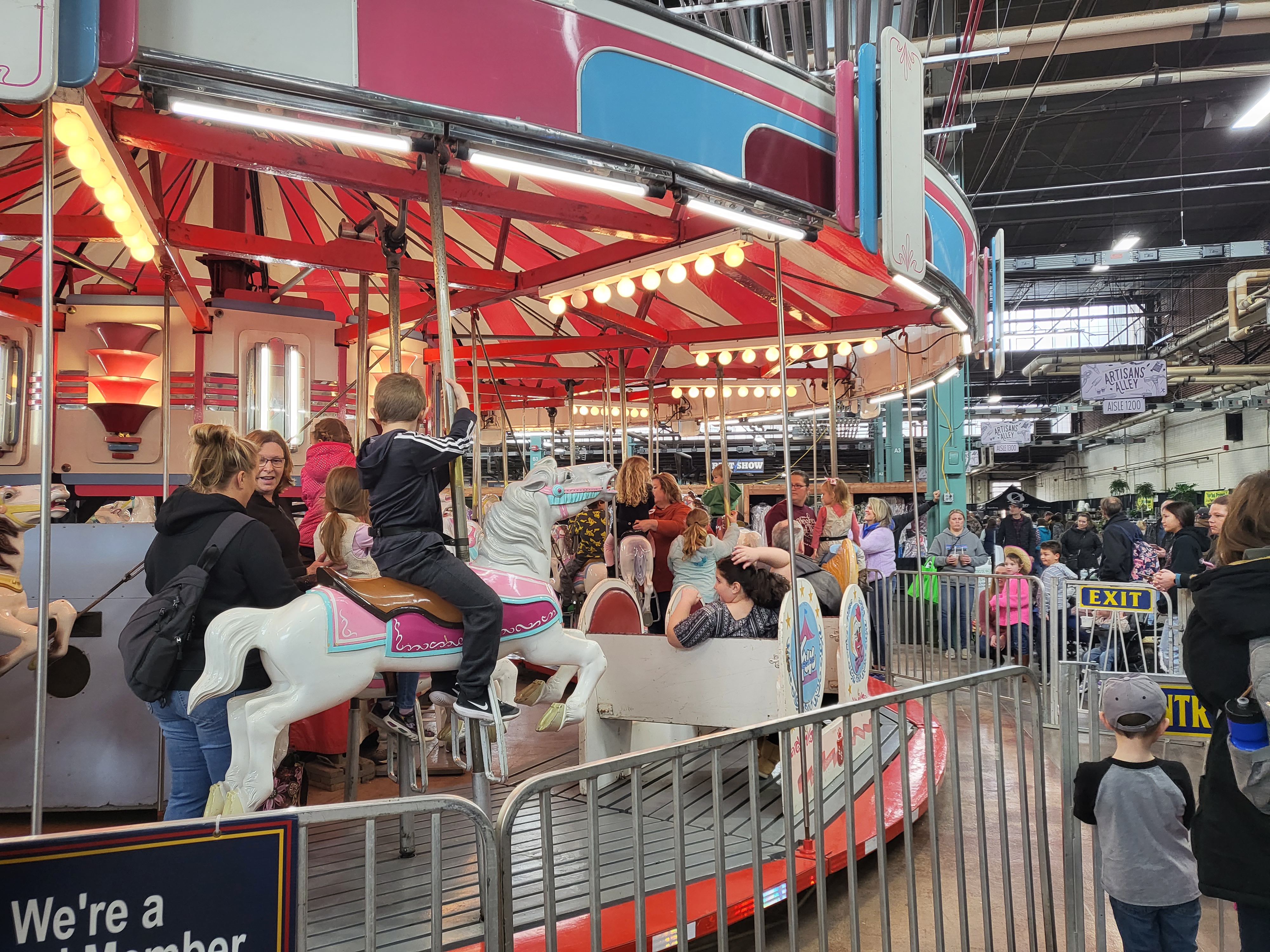
The Merry-Go Round is also popular with the many children who visit the Farm Show.

One exhibit that results in much hoopla is the butter sculpture, which is unveiled dramatically every year and covered by the area news. We learned this year that the tree leaves were fairly problematic and kept falling off until they lowered the temperature in the enclosure.
This year's butter sculpture.

Competitions are plentiful during the event and visitors will have the chance to see the blue ribbons that are awarded to a variety of growers and makers. People regularly show off their skills by entering their homemade baked goods in various competitions. Judges award blue ribbons to chocolate cakes, angel food cakes, whoopie pies, brownies, apple pies, sticky buns and more. Visitors often take note of those who win the beer, wine and cider competitions in order to track them down to try their products at a later date.

Demonstrations are held to educate and fascinate, like the "sheep-to-shawl" exhibition where sheep owners, armed with a pair of knitting needles, demonstrate how they make a wrap, right off the back of the standing sheep.

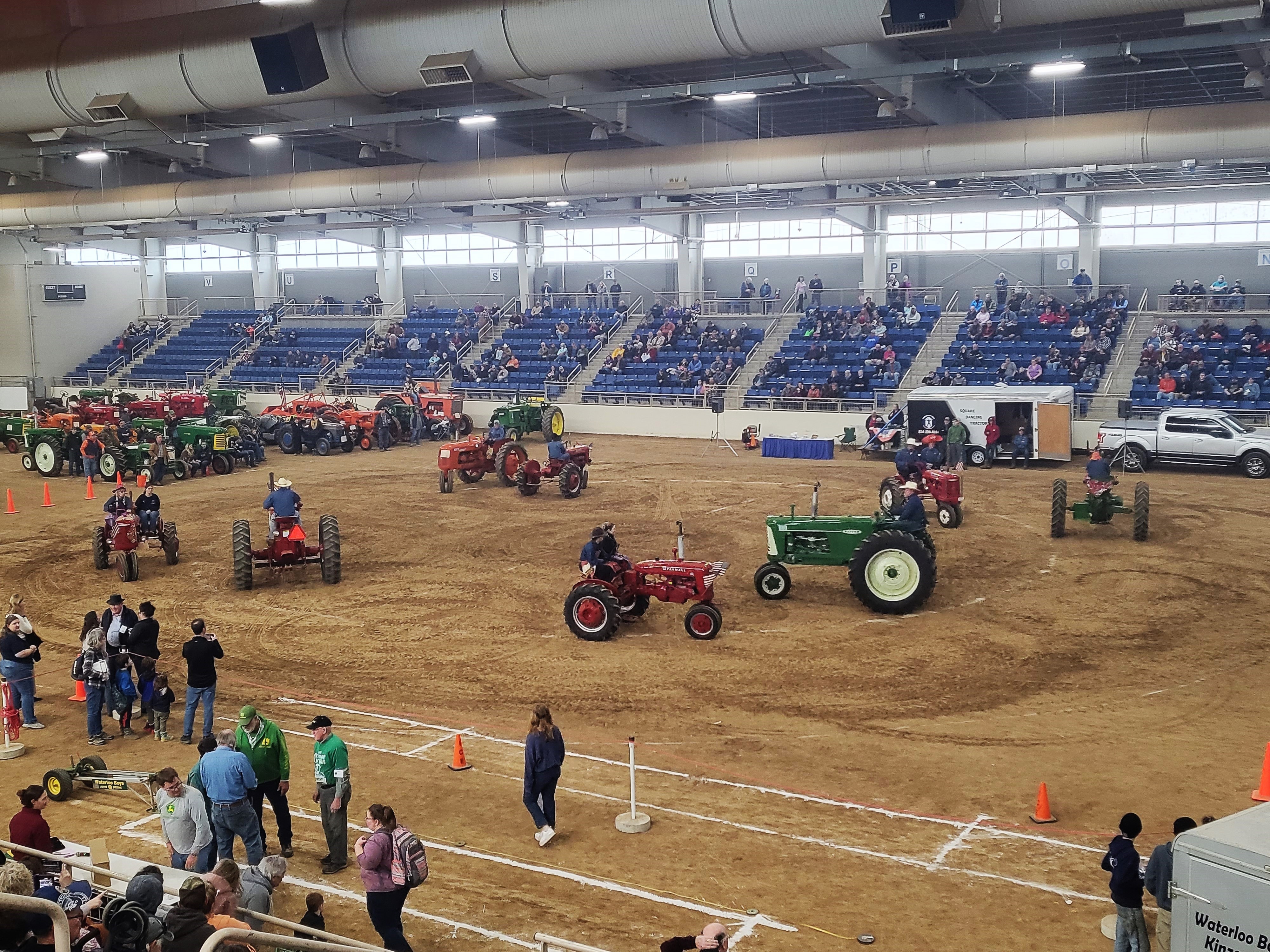
City folks, in particular, are often amused at the Square Dance Competition and the real-life rodeos complete with rodeo clowns, not to mention the pony pulling contests, the antique tractor pulls, the bid-calling contest, the corn-hole contest and the tractor restoration awards.

"Tractor Square Dancing" was taking place on the day I visited.


Another Farm Show draw is the food court where guests can indulge in milkshakes, baked potatoes, fries, donuts, pulled pork, chicken corn soup, hot dogs, sticky buns, deep-fried vegetables and more. One of the drawbacks of the food court is that chairs to sit and eat are hard to come by, so most people end up standing and eating at tables, that is if they can find an open space.

Vendors also sell Pennsylvania food products.

Those who don't end up eating at the food court sometimes make a short trip to the nearby Subway Café on Herr Street where there is usually a line and a run on pizzas during Farm Show week. I know that because I supplemented my full-time income by working there part-time in my 20s. Their pizzas are delicious, with a light cracker-like crust, and come highly recommended not only by locals, but also by our local newspaper, which held a pizza challenge some time ago. You can read more about the history of this quaint little place in a story I wrote for The Burg News here.

Taking along a little extra cash is a good idea if you wish to purchase items from the many exhibitors, who sell everything from candy, to hemp products, art and more. The sprawling complex may, at first, be overwhelming to some, which is why many study the maps they give out at the front door to help them make their way through the maze of rooms.


My three favorite birds, all in one painting in this work by Gerald Putt.

I might also mention that although the Farm Show is free, there will also be a charge of $15 to park, whether you park onsite, or at an offsite lot to be shipped in by bus. Also keep in mind that they won't take cash. If you're staying locally, an Uber might be the way to go.

I often wonder how many out-of-towners come in to Harrisburg for the Farm Show and then just leave, not knowing that we're not as countrified as we seem. In fact, our State Capitol is a must-visit while you're in town. It is just a 10-minute drive away and the building is known as one of the most beautiful capitols in the entire country.

The Pennsylvania Farm Show takes place every January, runs for eight days and is held at the Farm Show Complex located at 2300 Cameron Street in Harrisburg.


Tuesday, December 20, 2022

There's More to Gettysburg Than Just the Battlefield

History buffs love visiting the Gettysburg battlefield to learn about the infamous and bloody three-day battle. Over the years, I've visited the area many times, even touring the battlefield via Segway, which in my opinion is the best way to do it. 

I've also taken ghost tours, which can be filled with historical tidbits and can be very interesting, as well.

However, my favorite thing to do is simply stroll around the downtown area, enjoying the little boutique shops, dining at the restaurants, taking part in tastings at the wineries and learning more about some of the structures identified by historical markers. 

A tasting at Reid's Winery Tasting Room and Cider House on Baltimore Street.

One of my favorite downtown buildings inspired me to reach out to author Brad Gottfried to learn more about the structure pictured below. Gottfried knows the Gettysburg area well, having written 17 books on the subject. He informed me that the structure was once a service and parking garage--which was quite a let down, being that it is so attractive. If you zoom in on the information underneath the arch, you'll see that it dates back to 1916. They sure knew how to park in style back then, I said to myself, wondering why modern-day parking garages needed to be so brutalist. These thoughts went through my head when I began researching and discovered through the 'Celebrate Gettysburg' facebook page that it was initially intended for a movie theater, until a hotel moved in nearby, necessitating the need for parking. That made more sense.

This beautiful building once served the community as a parking garage.

After I got over the notion that this beautiful building was used for parking, Gottfried took me on a tour where he offered details on other points of interest and I left knowing much more about the interesting and walkable downtown area.

Historical Houses

The Will's House

"Return Visit" is built to scale.

One of the most-oft photographs of downtown Gettysburg is the statue of Lincoln standing beside a tourist near the David Wills Housewhere he worked on his famous Gettysburg Address. Artist J. Seward Johnson, Jr., of Johnson & Johnson pharmaceutical fame, was responsible for creating the now-famous piece, which shows Lincoln pointing up at the room in which he stayed. I've always been rather fascinated with Seward Johnson's life-like sculptures. You can view more of them at the Grounds for Sculpture in New Jersey. Once you've seen a Seward Johnson piece, you'll recognize it immediately. (You can see more of Seward Johnson's work and read about the Grounds for Sculpture in a blog I wrote here). This statue that stands on the Gettysburg square is called "Return Visit."

The Will's House, for a long time, charged admission. Today it is free and contains six galleries and two rooms that have been restored to their 1863 appearance. 

The Farnsworth House


The Farnsworth House Inn not only serves as a Bed and Breakfast, but also as a place to stop and have a bite to eat after a day of touring. 

The Inn was named after Brigadier General Elon John Farnsworth of the Union Army, who died in battle along with 65 of his men after being ordered by Major General Hugh Judson Kilpatrick to lead an unsuccessful charge against Confederate positions south of the Devil’s Den area.

The back part of the house, now featuring Sweney’s Tavern, was built in 1808, while the front of the house was added in 1833. Banker John McFarland, who built the house, fell on hard times and sold it to the Sweney family, who owned it during the battle.

Furious fighting began almost immediately when the Confederates inhabited the house during the very first day of the war. Confederate sharpshooters positioned themselves at a tiny window in the attic, shooting towards Cemetery Hill while laying on their stomachs. In fact, the shot that killed Jenny Wade, the only civilian directly killed in the battle, was said to have come from that very window. More than 100 bullet holes now riddle the walls of the house.

The Shriver House

Another interesting house near downtown is the Shriver House Museum and one that is foremost in my mind because of how I felt during a tour of the place. As we gathered around a docent, I began to feel a debilitating pain my stomach as if someone was twisting my insides. This was followed by a bit of panic and sweating and I wrestled with interrupting the docent by telling her, or fleeing, but I stuck it out, not wanting to create a scene and the feeling passed within a few minutes.

I learned later that the house was used as a hospital during the war. Was I feeling the way one of those soldiers felt after being shot in the stomach? I guess I'll never know.

Tourists who want to learn how people lived in the period of time before, during and after the Civil War get a clearer picture after visiting the Shriver House.

In the attic is a sharpshooter's nest where two confederates died.

Sharpshooter's nest in the attic of the Shriver House.

The Majestic Theater
The Majestic Theater dates back to 1925.

Downtown Gettysburg is also home to the Majestic Theater, which dates back to 1925 and at the time was known as the largest vaudeville and silent movie theater in south-central Pennsylvania.

In the late 1950s, it wasn't unusual for patrons to take a seat, only to spot Mamie and Dwight Eisenhower in the audience. 

In 2005, the theater underwent restoration to bring it back to its original charm and today people visit to enjoy music acts, comedians and classic films.

Learn about History during a Virtual Reality Experience

The Gettysburg train station.


Located a few steps away from the Majestic Theater is one of the newer attractions operated by the Gettysburg Foundation. "Ticket to the Past," located at the Gettysburg train station, transports visitors back to 1863 when the structure served as a hospital, a supply station and a presidential arrival platform.

Bringing stories to life are: Cornelia Hancock, soldier caregiver and hospital heroine, Eli Blanchard, soldier, musician and amputation assistant and Basil Biggs, Gettysburg Resident and Facilitator for the Fallen (exhuming Union soldiers for reburial). Visitors will also witness a recreation of Lincoln's arrival in Gettysburg and learn more about this important period of time in our nation's history.

For tickets, visit GettysburgFoundation.org/Ticket-to-the-Past.

Shopping Opportunities Abound

LARK is located in a historic building on Lincoln Square.


LARK carries this cute selection of clocks that I'm always tempted to buy.

One of my favorite places is LARK, especially during the Christmas season. If you're at a loss as to what to buy as a gift for someone who seemingly has everything, LARK is the place to go.The 5,000 square foot shop, which opened in 2011, is located in an historic building located at 17 Lincoln Square on one of the original 210 lots developed in 1785 by James Gettys. 

Other shops downtown offer everything from art, to home decor, jewelry, apparel and more.  Gallery 30, at 26 York Street, is another shop you won't want to miss. Below are a few shots of the many interesting and beautiful items that they sell.


Dining Downtown

There are plenty of places to eat in the downtown area. One of my favorites is the historic Dobbin House Tavern, listed on the National Register of Historic Places. This popular restaurant and Inn is known as Gettysburg's oldest building and was built by Reverend Alexander Dobbin, an early pioneer who helped settle the area. Dobbin needed a large house to not only accommodate his first wife and 10 children she bore to him, but his second wife who came along with nine additional children after the first one died. You can probably imagine that space might be a huge deal to him and his family, but also for the students at the school he founded. "The Classical School" was a combination theological seminary and liberal arts colleged and was one of the first in the area west of the Susquehanna River.

The Dobbin House contains seven cozy fireplaces that are often lit in the winter, as well as original stone walls and woodworking that has been restored to appear as it did during the days of Dobbin. To add to the charm, the waitstaff greets customers in colonial clothing. What is even more interesting, however, is that the silverware and china that are used at the restaurant. They were recreated to match fragments that were discovered during a cellar excavation.

Restaurant customers dine by candlelight and can tuck into items like crab cakes, filet mignon and prime rib. Downstairs at the Spring House Tavern, customers will experience an equally interesting, yet more casual atmosphere where sandwiches and salads are served. I suggest getting there early to avoid a long line for both places. Unfortunately, neither takes reservations at this time, but both are open seven days a week for lunch and dinner.

If you like your libations, you may enjoy the only Irish-owned pub in Gettysburg, located at 126 Chambersburg Street. The Garryowen offers an impressive list of 120 Irish whiskies, a selection of Irish beer on draft, and other imported and domestic selections as well. Menu favorites are created from locally sourced ingredients and include Irish Stew, bangers and mash, authentic Shepherd's pie made from an old family recipe and Irish onion soup (made with Guiness stout). The Pub is open for both lunch and dinner and often features live music.

The Garryowen Irish Pub is the only Irish-owned pub in Gettysburg.

The Mahogany bar at the Garryowen at an unusual time before patrons arrived.

These are just a few of the places I enjoy when I visit Gettysburg. You may also be interested to know that, for such a historical place, it's not very crowded and parking is reasonable compared to many other places I've visited.

If you decide to take my advice and visit any of these destinations, the best place to set your GPS for is the Racehorse Alley Parking Garage, where you'll pay $1.00 per hour and if that's not a bargain for a major tourist destination, then I don't know what is.

Safe travels!