Showing posts with label Lancaster. Show all posts

Friday, October 14, 2022

Learning about William Penn at Pennsbury Manor

Few will argue that Pennsylvania is rich in history and even the small towns hold gems of information—just consult any local historical society and you’ll discover that to be true.

These past few years, I’ve spent time learning more about Pennsylvania history thanks to various organizations dedicated to keeping the past alive.

The front of the house, which faces the Delaware river.

A trip to Bucks county took me on an educational journey to Pennsbury Manor in Morrisville, where I learned a wealth of information about Pennsylvania’s founder William Penn, who became known as a champion of religious liberty and and a promoter of principles that laid the groundwork for the First Amendment.

For those who have yet to visit, Pennsbury Manor is the recreated home of William Penn on the Delaware River. Open to the public since 1939, the 43-acre site is comprised of 20 buildings designed to educate visitors on the life of those who lived during the early days when Pennsylvania was first founded.  A woodworker’s shop, a blacksmith shop, barns, stables, a woodshed, a “necessary,” (“outhouse”), a worker’s cottage and a Manor House are just a few of the buildings erected on the property.

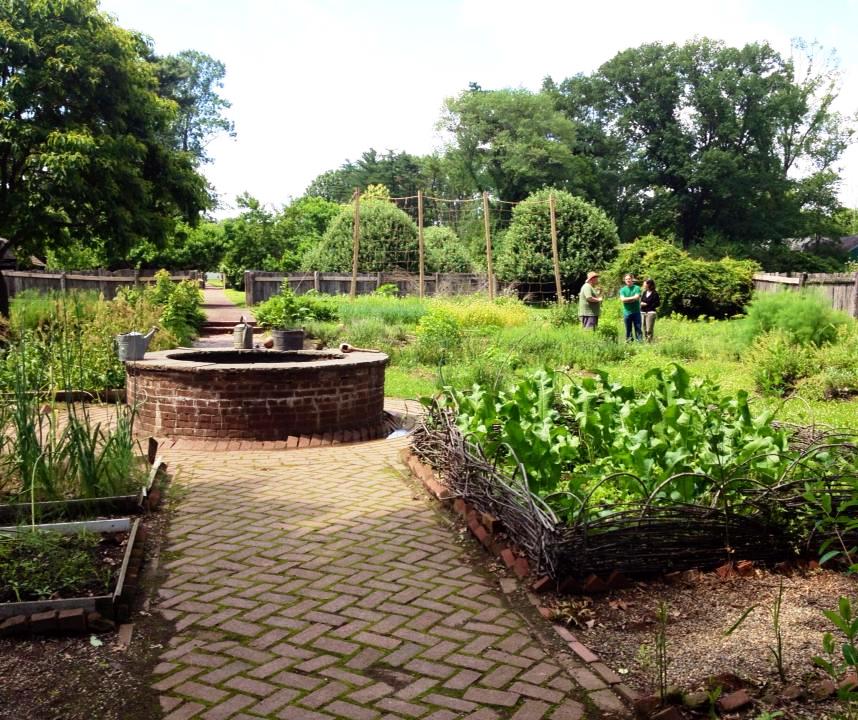
The garden at Pennsbury Manor.

An exhibit at the visitor’s center titled, “The Seed of a Nation” provides insight into the how Penn laid the groundwork for religious tolerance and representative government.  A detailed timeline takes visitors on a journey of the life of William Penn, describing periods of his life where he progressed from “Young Aristocrat,” to “Quaker Spokesman,” “Optimistic Proprietor,” and finally, “Disillusioned Leader.”  A large scrolling list enumerates the many religions that were practiced here thanks to Penn. Many are recognizable, others require the assistance of google.

They say behind every successful man is a strong woman and Penn’s wife Hannah Callowhill Penn is no exception. A timeline takes visitors through the highlights of her life and the role she played as a helpmate to Penn. She resided in the Manor house while Penn spent most of his time in England.

An attractive, tiled fireplace at the manor.

An eating area at the Manor.

Doug Miller, Pennsbury Manor Director, said that “The Seed of a Nation” earned a national award from the American Association of State and Local History and that the site is significant in that it is the only place in Pennsylvania dedicated to William Penn.

The bedchamber reserved for overnight guests.

A particularly colorful bedroom in bright shades of yellow and red stands in stark contrast to some of the less vibrant colors in most of the other rooms and is a curiosity to many. Miller explains: “You’d set aside the best bedchamber for the overnight guests. The color choice was based on a period example of a home in England called the “Hamn House,” and they were the royal colors at the time,” he said.

In addition to guided and group tours, Pennsbury offers 60 types of educational programming ranging from period cooking, to woodworking and blacksmithing.

A re-enactor cooks on an open hearth.


Matthew Russell, formerly of the Harrisburg area, spent several summers learning about history there at day camp. “The staff is well educated and it’s a good place to gain an understanding about William Penn’s contributions,” said Russell, who benefited from hands-on experiences like baking muffins using flour milled on the property and currants grown onsite. “From a young age I was interested in William Penn and the month-long experience was really immersive; it was a great experience,” he said.

To learn more visit: www.pennsburymanor.org

Friday, March 1, 2019

A Stay at an Amish Tobacco Farm-Turned Luxury Inn, Paired with an Over-the-Top Meal

I'm a big fan of Valentine's Day, mainly because requests that are shot down during the rest of the year have a better chance of making it past the "absolutely not" stage. I have to thank my husband for his indulgences in this area and for recently treating me to an item that was on my bucket list--a dinner at TÈ restaurant at the Inn at Leola Village located in Leola, Pennsylvania.

TÈ is located within an hour's drive from me in Lancaster County and is particularly special because it is one of the few restaurants in the United States that holds both a AAA Five-Diamond Award and a Forbes Travel Guide 5 Star Award.

To further guild the lily, he arranged a stay at the Inn at Leola Village in one of the most unique rooms on the property, the historic "Wine Cellar," which dates back to 1867 and was once part of the original farmhouse which is still there to this day.

The Inn at Leola Village
Inn
The entrance to the lobby at the Inn at Leola Village.
lobby
The lobby at the Inn at Leola Village features beams original to the property.
When Deborah Shirk and her husband, architect and chef John Calabrese, announced that they would be creating an upscale inn and restaurant in the heart of Amish country, area businesses scoffed and told them it would happen when "pigs fly." The couple, undaunted, proceeded with the project and showing their sense of humor, even adopted the flying pig as a mascot. If you visit the Inn, you'll see the winged creature represented throughout the property, often in some unlikely places.

The Inn at Leola Village, listed among the Historic Hotels of America, has received its share of awards and accolades since opening in 1999. It was named Best Meeting Venue by Pennsylvania Meetings & Events Magazine (2017) and recently received the Four Diamonds Award of Excellence (2018). The Inn was also recognized by The Knot as a Hall of Fame Designee (2018) and was nominated as Best Historical Hotel by the Historic Hotels of America (2018).

Sixty-two guest rooms are spread across seven buildings, with four buildings original to the property. Overnight guests can select from several restored antique homes, a restored tobacco barn, and other tastefully appointed accommodations, including my favorite--the wine cellar.
Inn room
The "Wine Cellar" suite was once the stone-walled cold cellar of the original restored farmhouse. It includes original wood posts and beams, along with a whirlpool, a fireplace, and a separate entrance.

Inn room

book nook
My favorite part of the "wine cellar," is this adorable reading nook.
The property also features an onsite bar where couples can relax with their preferred libation before, or after dinner.
bar
The bar at Osteria Avanti.

Inn
A room in a restored tobacco barn features a waterfall shower on the second floor. 
tub
The waterfall shower on the second floor rains into a whirlpool tub.
Inn at Leola
All rooms are spacious, no matter which one you choose.
The Inn at Leola has two banquet facilities and is particularly popular with brides and grooms who come from miles around. Wedding parties often take advantage of the Forbes-rated four-star spa where they can choose from among a variety of services, from body treatments, to massage, facials, make-up and hair and nail care. The team of onsite wedding professionals includes floral designers, pastry chefs, a resident deejay, photographer and more so that all the wedding party has to do is show up.

wedding area
The wedding area.

wedding reception area

catering hall
Suites located in the catering hall where bridal parties get ready for the big day.

TÈ Raises the Bar on Fine Dining

restaurant
Intimate and romantic, TÈ restaurant touts a mere six tables, with a staff the size of much larger restaurants.
The Inn at Leola Village features an upscale Italian restaurant which has earned its share of accolades. Since opening in 2012, it has consistently maintained two prestigious awards--the AAA Five-Diamond and the Forbes Travel Guide 5 Star Award. Few restaurants in the United States lay claim to both.

TÈ,which means tea in Italian, offers diners a one-of-a-kind experience in an intimate atmosphere. Reservations aren't just recommended, they're mandatory, which is something to keep in mind, along with the fact that dinner is served on Friday and Saturday only.
sandwiches wrapped like presents
Two sandwiches wrapped like little presents came with melted cheese and raspberry sauce for dipping. This set the tone for other little surprises during the course of the meal. 
Guests can choose a five-course, or a nine-course dinner, with the concept of taking a leisurely journey through Italy starting in the northernmost part and working one's way down to the warmer regions in the southern part. Customers can add to the experience by opting for wine pairings and the cheese trolley, which features more than 21 cheeses from Italy and France.
Fromagier
The cheese trolley features almost two dozen cheeses from Italy and France. A fromagier is on hand to explain the various selections and to answer any questions.
If you decide to enjoy this incredible experience, be sure to set aside a few hours. Our five-course meal stretched out for four hours, although it didn't quite feel that long since most courses were introduced with an amuse bouche. Pacing was excellent and service was attentive, with at least five employees for every couple.

Special touches included a stool strategically placed at knee-height so I wouldn't have to sling my purse over a chair, or place it on the floor and a warm finger bowl containing mint and rose petals, which enveloped the table in a lovely aroma.

We opted for the five-course prix fixe menu, which included salad, appetizer, fish and main courses.TÈ has a certified sommelier on staff and each of our courses were paired with Italian wines. Highlights of this incredible meal included yellowfin tuna with deep-fried fennel in a 15-year balsamic reduction, butter-poached halibut cheek with mint in a duck egg yolk, lamb, scallops and pork belly and the grand finale: the dessert mat, which was absolutely wonderful, from the little tortes and cakes, to the chocolate cherries the staff set aflame as we watched.

tuna
Yellowfin tuna with deep-fried fennel in a 15-year balsamic reduction.
halibut
Butter-poached halibut cheek with mint in a duck egg yolk.
cheese
We each selected five cheeses and were served candied nuts, bread and fruit alongside.
drink
One of many libations served during the course of the meal.
dessert
The spectacular, over-the-top dessert mat.

desserts

dessert

milk and cookies
There's the flying pig again. This is TE's version of milk and cookies, but by the time this course was served, it was 11 p.m. and we were stuffed, so they packed up a few of those chocolate-dipped, anise-kissed biscotti for us to take with us.
On our way out, we were helped with our coats and given a personalized menu with our names, the date and what we ate that evening to take home as a keepsake.

Part of our package included breakfast the following morning, so we headed over to the other onsite restaurant, Osteria Avanti, where I enjoyed a somewhat lighter meal of avocado toast. My husband ordered eggs and scrapple and we both laughed when the flying pig made yet another appearance.
breakfast
Avocado toast served at Osteria Avanti.

scrapple
The flying pig makes a final appearance in the form of scrapple.
I have to say I'm not likely to ever have such an extravagant experience again, but it certainly made Valentine's Day memorable--so that's a hint to the men out there--you have time to prepare for next year. An added plus is that if you live in Pennsylvania, you won't even need to hop on a plane.


Sunday, June 24, 2018

Ephrata Cloister Tells Tale of One of America's Earliest Religious Communities

house
The Ephrata Cloister

The small borough of Ephrata located in northern Lancaster County is home to one of America's earliest religious communities known as the Ephrata Cloister.

This carefully preserved gem, founded in 1732 by German settlers led by a man by the name of Conrad Beissel, tells a tale of Pennsylvania's role in the quest for freedom of religion.

Beissel, who was born in Eberbach, Germany, took issue with his country's state-run churches, believing, instead, that citizens should be free to worship as they pleased. When he set sail for North America, he decided to settle in the only colony at the time to offer freedom of religion. By choosing Pennsylvania, Beissel had shaken the shackles of his native country's demands for obeisance to the religion of the rulers.

After arriving in the colonies, Beissel initially settled in Germantown before moving to Lancaster County, where he led a Brethren congregation. His quest for inner peace and his desire to escape the distractions of the world eventually led him to Ephrata to create a religious retreat. 

Soon others were joining the charismatic Beissel and by 1750 approximately 80 men and women comprised the "Community of the Solitary" at Ephrata. All agreed to live a regimented, celibate life to better worship God.

Today the Ephrata Cloister is recognized as a National Historic Landmark, run by the Pennsylvania Historical and Museum Commission. Tours are conducted seven days a week until December and several days a week thereafter.

Taking the Tour
Parking is plentiful at the Cloister and a short walk takes guests to a Visitor's Center where they will be greeted by a guide in a simple, long, hooded, white robe, the traditional garb that residents were required to wear at the time.

After viewing a short film on Beissel and his pursuit of religious freedom, visitors are led to outside benches. There, in the midst of historic buildings that have been described as some of the most significant, surviving examples of pre-colonial architecture in America, guests learn more about the unique community.
Guide gives insight into the community that lived onsite.
Members of the sect led a life of discipline and celibacy, indulging in only one meager meal a day and sleeping six hours a night. The purpose of such self-restraint, according to Beissel, was to prepare his followers for heaven through earthly denial. Sleeping accommodations were comprised of a bench and a wooden pillow and the six hours of sleep were broken into two three-hour periods, interrupted for a time of worship in the onsite meeting house.
Bed with wooden block pillow.


book
Bible in the Meeting House

Members spent the remaining hours of their days engaging in a variety of jobs ranging from gardening, to milling, mending, cooking and other tasks related to the upkeep of the compound. The brothers and sisters even purchased a printing press and were responsible for printing the largest book in the colonies at the time. "The Martyr's Mirror" spans 1,500 pages and describes the early persecution of the Anabaptists. To this day, it is treasured by the Amish.
church
The Meetinghouse
Dining area
spinning
Spinning Area
oven
Squirrel Tail oven
Guest cottage
After a short introduction to the life of the people who lived in the Cloister, guests are guided to the Saron, otherwise known as the Sister's House, where members ate, slept, cooked and worked. The second stop is the Saal, or meeting house, known as one of the oldest places of worship in Pennsylvania--where residents listened to sermons conducted by Beissel. Song, penned both by Beissel and his followers, sometimes contained an astonishing 300 verses.

At the end of the tour, guests are given the opportunity to explore the grounds and outbuildings, sometimes with the help of modern technology. Guests can dial phone numbers listed on buildings to learn more about each structure.

Within the Cloister is also a cemetery, where visitors can see the headstones of those who have been laid to rest, including leader Conrad Beissel, whose passing in 1768 led to the slow demise of the community, after the takeover by Peter Miller, who believe that the monastic life was no longer attractive to new generations.
tombstones
The Cemetery
grave


By 1777, a third of the members died of typhoid and by 1814, the Community of the Solitary at Ephrata dissolved as the last four followers joined the Seventh Day Baptist Church, marking an end to the "holy experiment."

To learn more, visit: www.ephratacloster.org.


Tuesday, August 1, 2017

Visiting Lancaster's Conestoga House and Gardens


gardens

Garden lovers still have time before the summer season ends to visit the Conestoga House and Gardens located at 1608 Marietta Avenue in Lancaster, Pennsylvania. Once home to James Hale Steinman and his wife Louise McClure Tinsley, the gardens of the plush, 20-acre property are open to the public through September.

The couple purchased the land, including the original house and several outbuildings, in 1927. Philadelphia architects Mellor, Meigs and Howe were commissioned to design extensive additions and modifications, creating what has been described as an outstanding example of Colonial Revival architecture. The work was completed in 1929, and the Conestoga House itself has remained essentially unchanged since then.
Steinman
Mr. and Mrs. Steinman
The Lord of the Manor
Col. James Hale Steinman was a Yale graduate, a practicing attorney, a WWI veteran and an entrepreneur, with a keen interest in radio and television. By the 1930s, he and his brother owned nine AM stations in eastern Pennsylvania and Delaware and in 1949, the brothers founded WGAL-TV as one of the first VHF television station in the country. At the peak of their interest, the Steinman brothers owned six stations.

Steinman could be described as a "media mogel" in his neck of the woods and developed an interest in print, as well, serving as President and co-publisher of Lancaster Newspapers, Inc., which today is known as LNP Media Group, Inc.

After Colonial Steinman’s death, the house and grounds were incorporated as part of the James Hale Steinman Conestoga House Foundation.

The Lady
Louise McClure Tinsley Steinman was born in Nashville, Tennessee to a direct descendant of Charlemagne. Her interests included showing saddle horses, traveling, antiques and, of course, flowers.

A civic-minded individual, Mrs. Steinman served on numerous boards and in 1974 created the Louise Steinman von Hess Foundation to preserve historically significant buildings in Lancaster County. One of her first endeavors was to restore Columbia's Wright's Ferry Mansion to its original state.
She also helped establish the Louise von Hess Foundation for Medical Education to provide continuing education for Lancaster area physicians.

Ms. Steinman passed away on November 12, 1980, nearly 18 years after her James Hale Steinman's death.

The Parties

Louise and James became known for their bridge parties, tennis matches and other outdoor entertainment in the gardens. The couple hosted international celebrities and high-ranking business and government officials and invitations were highly prized. Said one social columnist in 1946, “Everyone who visits the James Hale Steinmans in Lancaster hints like mad for a return invitation. The reason one casts the amenities to the wind and resorts to such out-and-out measures is the combination of beauty, comfort and fun that Conestoga House offers to every one of its continuous stream of weekend visitors.”

patio
sunroom


The Grounds
Today guests can stroll the grounds and imagine what it was like to snag a coveted invitation to the place where the rich and famous frolicked at what was then known as one of the largest residences in Lancaster County.


Rose
160 rose bushes representing 20 varieties of roses can be seen on the grounds. 
The current horticultural collection includes 3,300 annuals, a collection of bonsai, 400 tropical plants, 160 varieties of perennials and more than 20 types of roses. A selection of topiary, flowering Urns, and window boxes add a bit of a European flair, providing additional visual interest.
topiary
Topiary 
flower
Passion Flower

hibiscus
Hibiscus

Cactus
outside garden room


sitting area
Sitting area outside at Conestoga House and Gardens

pool
One of the first in-ground pools installed in Lancaster County

The pool "complex," with its 60-foot swimming pool, bathhouse and dance floor is used today by various civic groups for picnics and special events. Nearby, guests can relax in a shady sitting area built atop a lime kiln in view of a collection of tropical plants.

One of the newest installations includes a water garden featuring hardy lilies, aquatic plants and thriving koi.
lily
Water Lilly 

Tours are self-guided for groups of 15 or less. Groups of more than 15 can make arrangements for a guide by calling in advance. Gardens are open from mid-June through September. Directions and hours can be found on the website at https://conestogahouse.com